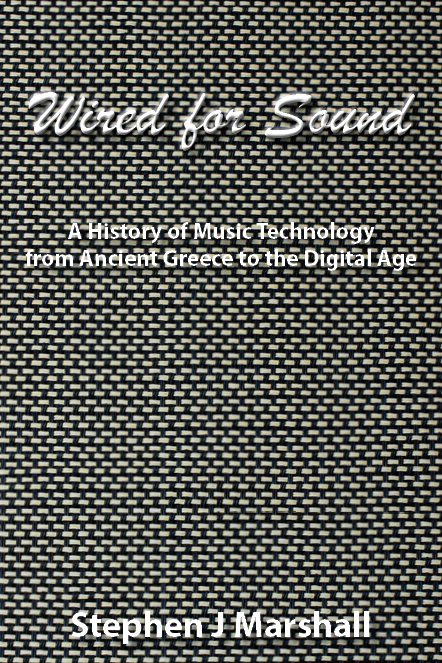
After more than three years of effort (and only slightly behind schedule) my latest book is now finished and available from Amazon in both paperback and eBook formats. Weighing in at just over 110,000 words, Wired for Sound is a history of music technology from ancient Greece to the digital age. It covers the development of musical instruments using mechanical, electrical and electronic means, the science of sound, the development of equipment for sound recording and reproduction, the evolution of the electronic synthesizer, and how digital technology has transformed the way in which music is created, performed, recorded and reproduced.
As discussed in an earlier post (The March of Progress), conducting the research for this book has been easier than on previous occasions due to a significant increase in the amount of source material available online. However, the writing has remained as time-consuming as ever. By my calculations I’ve been averaging around 125 words per day, which is very low in comparison with some novelists who can write 1,000 words or more per day. Of course, writing non-fiction requires constant fact-checking, which slows progress, and non-fiction books also tend to be longer than fiction titles, so I probably shouldn’t feel too bad about my paltry daily word count average and the time I’ve taken to complete the book.
A new development since the completion of my previous book has been the introduction of generative Artificial Intelligence (AI) writing tools. Given the time-consuming nature of non-fiction writing, it would be tempting to use these tools to help accelerate the process. However, generative AI uses existing works as training data, thereby threatening the rights of the copyright holders of these works unless prior permission has been obtained. Like most authors, I would not want my own works to be used as AI training data so I certainly would not wish to take advantage of the uncredited efforts of others by using these tools in my writing, no matter how tempting that may be.
AI technology is already impacting the music industry with AI-generated songs and in the introduction to Wired for Sound, I mention that many people in the industry believe that it diminishes the role of songwriters and musicians and devalues human creativity. As this technology becomes increasingly sophisticated, it is only a matter of time before it will be able to generate a convincing full-length book. Given that generative AI is much better suited to gathering and summarising factual information than producing creative prose, it is the writers of non-fiction books who are likely to be the first to feel its impact. I’m not normally pessimistic when it comes to new technology but in this case I would advise any non-fiction writers currently working on a book to get their skates on and publish it ASAP, otherwise their new book is likely to become lost amongst a sea of AI-generated titles.

