Re: The March of Progress

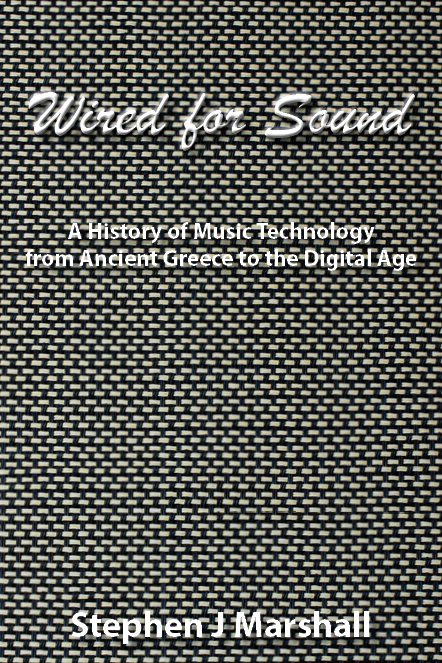
After more than three years of effort (and only slightly behind schedule) my latest book is now finished and available from Amazon in both paperback and eBook formats. Weighing in at just over 110,000 words, Wired for Sound is a history of music technology from ancient Greece to the digital age. It covers the development of musical instruments using mechanical, electrical and electronic means, the science of sound, the development of equipment for sound recording and reproduction, the evolution of the electronic synthesizer, and how digital technology has transformed the way in which music is created, performed, recorded and reproduced.

As discussed in an earlier post (The March of Progress), conducting the research for this book has been easier than on previous occasions due to a significant increase in the amount of source material available online. However, the writing has remained as time-consuming as ever. By my calculations I’ve been averaging around 125 words per day, which is very low in comparison with some novelists who can write 1,000 words or more per day. Of course, writing non-fiction requires constant fact-checking, which slows progress, and non-fiction books also tend to be longer than fiction titles, so I probably shouldn’t feel too bad about my paltry daily word count average and the time I’ve taken to complete the book.

A new development since the completion of my previous book has been the introduction of generative Artificial Intelligence (AI) writing tools. Given the time-consuming nature of non-fiction writing, it would be tempting to use these tools to help accelerate the process. However, generative AI uses existing works as training data, thereby threatening the rights of the copyright holders of these works unless prior permission has been obtained. Like most authors, I would not want my own works to be used as AI training data so I certainly would not wish to take advantage of the uncredited efforts of others by using these tools in my writing, no matter how tempting that may be.

AI technology is already impacting the music industry with AI-generated songs and in the introduction to Wired for Sound, I mention that many people in the industry believe that it diminishes the role of songwriters and musicians and devalues human creativity. As this technology becomes increasingly sophisticated, it is only a matter of time before it will be able to generate a convincing full-length book. Given that generative AI is much better suited to gathering and summarising factual information than producing creative prose, it is the writers of non-fiction books who are likely to be the first to feel its impact. I’m not normally pessimistic when it comes to new technology but in this case I would advise any non-fiction writers currently working on a book to get their skates on and publish it ASAP, otherwise their new book is likely to become lost amongst a sea of AI-generated titles.

The March of Progress

After starting work on my third book in January 2023, I’ve been making steady progress. With initial drafts of the first five chapters now done and dusted (out of a planned total of nine), I’m currently more than halfway through and anticipating completion in early 2026. As reported in my previous post, the subject of the book is the history of music technology. However, it won’t cover the development of acoustic musical instruments as there are many excellent books available on that subject already. Instead, it will concentrate on the application of mechanical, electrical and electronic technology to music.

You can get an impression of the scope of the book from the chapter headings and subheadings:-

  1. The Mechanical Age
    • Music Technology in the Ancient World
    • Early Self-Playing Musical Instruments
    • Musical Clocks
    • Musical Automata
    • Automating the Orchestra
    • Self-Playing Instruments for the Masses
  2. Understanding Sound
    • The Nature of Sound
    • Giving Machines a Voice
    • Acoustics – The Science of Sound
  3. Sound Recording and Reproduction
    • Telephonic Technology
    • Mechanical Sound Recording and Reproduction
    • The Player Piano’s Last Hurrah
    • The Gramophone Goes Electric
    • The Advent of Magnetic Recording
    • The Mixing Console
    • The Birth of the Compact Cassette
  4. Electromechanical and Electromagnetic Instruments
    • Experimental Beginnings
    • The Electrification of the Organ
    • The Electrification of the Piano
    • Stringless Electric Pianos
    • Electromechanical Percussion Instruments
  5. The Electrification of the Guitar
    • The First Electric Guitars
    • Solid Body Guitars
    • Going Mainstream
    • The Humbucking Pickup
    • The Piezo Alternative
    • Creating a Mass Market
  6. Analogue Electronic Instruments
    • Creating Sounds Electronically
    • Continuous Pitch Instruments
    • Experimental Pioneers
    • The Development of the Electronic Organ
    • Establishing a Commercial Market
  7. The Advent of the Electronic Synthesiser
    • Conception
    • Commercialisation
    • Duophonic and Polyphonic Synthesizers
    • Electronic Speech Synthesizers
    • Drum Synthesizers
    • Electronic Drums
    • Guitar Synthesizers
  8. The Digitalisation of Musical Instruments
    • Digital Sound Generation
    • The First Digital Musical Instruments
    • Commercialising the Digital Synthesizer
    • Digital Sampling
  9. Digital Recording and Reproduction
    • Digital Recording
    • The Compact Disc
    • The Dawn of the Digital Audio Workstation
    • Digital Audio Players
    • Digital Audio Streaming

Although the writing hasn’t gotten any easier third time around, I’ve found that conducting the research for this latest book has been eased slightly due to an increase in the amount of source material available online. When writing my first book, The Story of the Computer: A Technical and Business History, which I started working on in 2003, I relied heavily on the extensive physical collections of the University of Glasgow library for my research, as much of the source material required was not available online at that time. With my second book, The Story of the Robot: A Short History of Automation and Robotics, which I started working on in 2017, the situation had improved considerably but I still had to seek out physical copies of some of the source material. This time around I’ve been able to find almost everything I need online which has saved me a huge amount of time in carrying out my research.

One of the most useful online resources has been the Internet Archive, a web archive and digital library founded by the American internet entrepreneur Brewster Kahle. It’s absolutely huge and well worth checking out if you are carrying out any research of your own.

That Difficult Third Album

Having completed and published both the paperback and eBook versions of The Story of the Robot in July last year after nearly 3 years of effort, I was in no hurry to start another writing project. I’d succeeded in proving to myself that I could write a second book. Also, having covered the two areas of technology which I can claim some expertise in (computers and automation systems), I reckoned I had run out of suitable topics to cover.

However, there was one piece of unfinished business. When writing my first book, The Story of the Computer: A Technical and Business History, I’d omitted planned chapters on supercomputers and portable computers in order to keep the overall length of the book manageable. Perhaps one of these could be the subject of a new book?

I quickly ruled out supercomputers. Supercomputing is a highly specialised subject and my experience of it is limited so a full-length book on its origins and evolution would be a tall order for me and probably also of little interest to potential readers. That left portable computers.

I have to confess to disliking portable computing devices. I get frustrated by their tiny virtual or physical keyboards, miniscule screens and absence of a decent pointing device. I don’t actually want to compose an e-mail while walking down the street or in the back seat of a taxi. I’d rather do it from the comfort of my desk, where I can give the task my full attention without fear that my user experience will be severely compromised by the Lilliputian nature of the equipment. Despite this, I can’t help marvelling at the ingenuity of their design and the enormous effort that has gone into their development.

Therefore, in August 2022 I began scoping out a book on the history of portable computing technology with the working title ‘A Moving Story‘. After a few weeks of intensive research I had a rough outline of the new book, complete with chapter headings, subheadings and bullet points for content. The next stage would be to take each chapter outline and expand it into working draft but I now realised that I’d be going over much of the same old ground as The Story of the Computer, as portable computers are still computers after all, and this dampened my enthusiasm considerably. I needed to find a different subject if I was to have any hope of writing a third book, a subject that I had both the enthusiasm for and sufficient knowledge of.

In September 2022 I attended a reunion of former colleagues from the University of Glasgow. During a conversation with one of my oldest ex-colleagues, I mentioned my struggle to find a suitable subject for a third book. Knowing that I was a keen amateur musician with an abiding interest in the technological aspects of music making, he suggested the history of music technology. After mulling this suggestion over for a couple of months, I decided that it was indeed the right subject for my next book.

I’ve now completed an outline for the new book, which has the working title ‘Turn Up the Volume‘, and have started work on the first draft of Chapter 1. Music technology overlaps with automation and computing at several points in its history, which gives the book a sense of continuity with the two earlier books while remaining a standalone work. Progress was slow to begin with due to the large amount of background research required for a “new” subject but is now accelerating rapidly as my enthusiasm builds. The target date for completion is early 2026 so watch this space!