Posts

A Pascaline for Sale?

Last week the BBC reported that one of Blaise Pascal’s ‘Pascaline’ calculating machines dating from the 1640s had been withdrawn from sale by Christie’s auction house after a Paris court provisionally blocked the historic item from being exported. It has been valued at between €2 millon and €3 million (£1.7 to £2.6 million), being one of only 9 of the 50 or so original machines known to have been made by Pascal to have survived and the only one still in private hands.

Having written about Pascal’s calculating machines in some detail in Chapter 1 of The Story of the Computer and knowing how important they were to the development of mechanical calculators, I was fascinated to read this article. However, after checking out the accompanying press release on the Christie’s web site, my fascination turned to dismay, as it contains several factual errors, some of which were also picked up in the BBC article.

Christie’s describe the Pascaline as “the first attempt in history to substitute the human mind with a machine“, ignoring the earlier efforts of Wilhelm Schickard who is known to have invented his ‘Calculating Clock’ calculating machine in 1623, the same year that Pascal was born. The press release also states that the Pascaline represents “… the first time in history mental arithmetic had been mechanized” which is again incorrect. Irrespective of Schickard’s work, it could even be argued that Napier’s Bones, invented by John Napier in 1617, were the earliest attempt to mechanise mental arithmetic.

Of course, auction houses are sales organisations and a little hyperbole might be expected in their efforts to obtain the best price for their clients and themselves. But they also have a reputation to uphold, particularly the old established houses such as Christie’s, and it does them no good to be so blatant in their disregard for historical facts.
The Importance of Computer Graphics

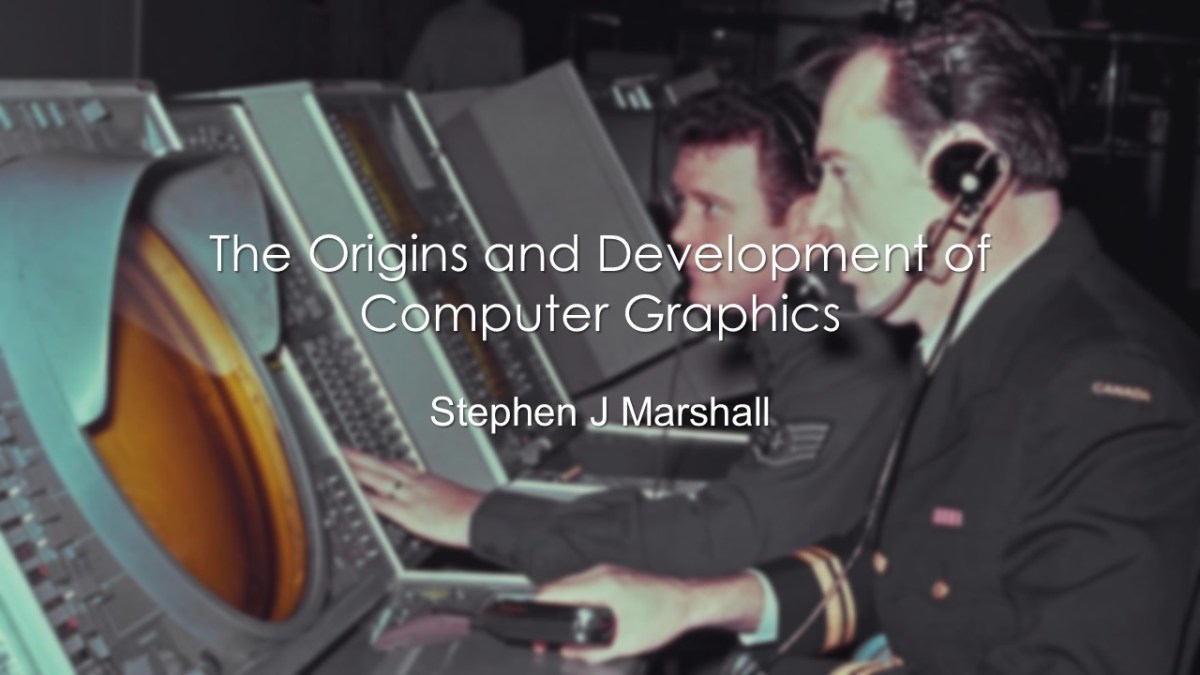
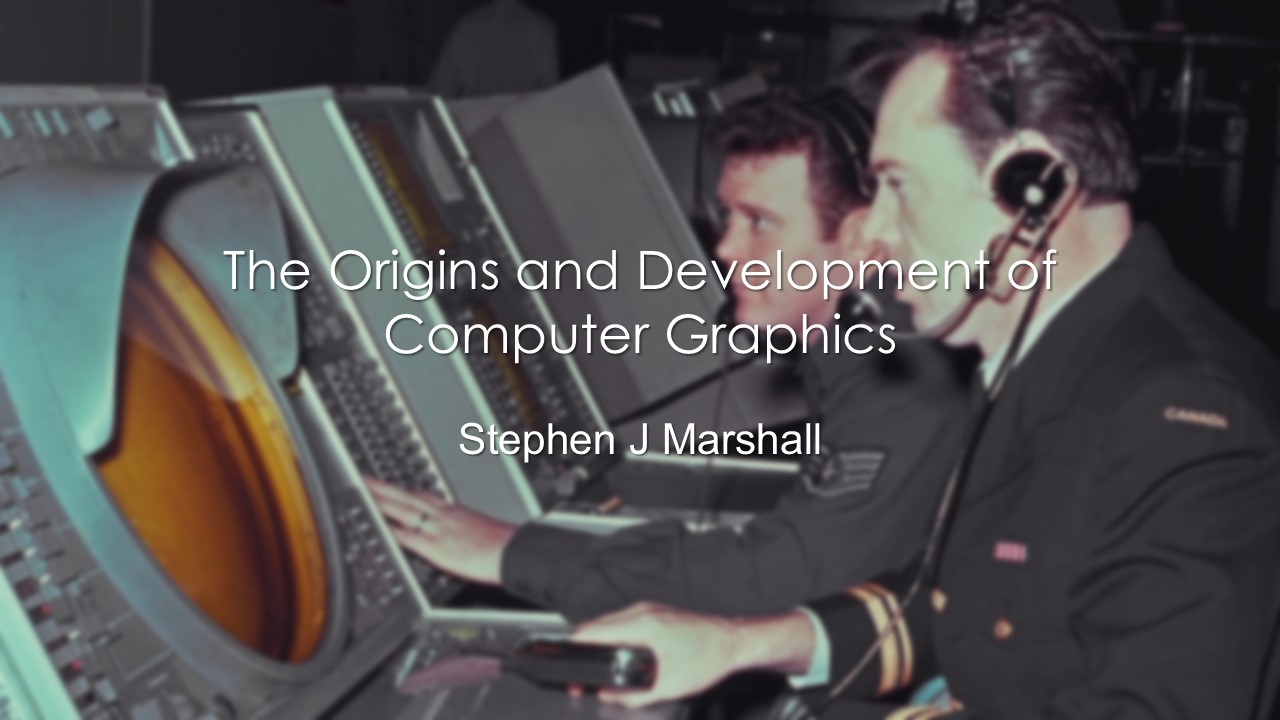
I recently gave a talk at a meeting of the Edinburgh branch of the British Computer Society. The title of the talk was ‘The Origins and Development of Computer Graphics‘. It’s a revised version of a talk I gave a few years ago at another BCS branch meeting, with fewer slides but adding information on graphics pipelines and GPUs.

Here is the synopsis:-

Computer graphics are everywhere, from the smartphone in your pocket to tablets, laptop and desktop computers, video games, public information displays, CGI in films – the list is endless. We think of computer graphics technology as originating with the early video games of the 1980s and 1990s, however, its development goes back to the very beginning of electronic computation. In this presentation I will trace the fascinating history of computer graphics from its source in Project Whirlwind at the Massachusetts Institute of Technology in 1949 through the developments in timesharing and computer-aided design of the 1960s and ‘70s to the high-quality interactive graphics that give today’s personal computing devices their amazing capabilities.

You can download a copy of the slides from the talk here.

A Trip to Paris

Last week I had the pleasure of giving two talks on the history of the computer at the Paris headquarters of the quantum computing company Pasqal. During my visit I was given a tour of the company’s labs and was shown how they are able to manipulate atoms using lasers in order to create arrays of ‘qubits’, the fundamental unit of information in quantum computing. It’s an incredibly complex process which requires a room full of delicate equipment to accomplish. The technology is still at a relatively early stage but the results are encouraging.

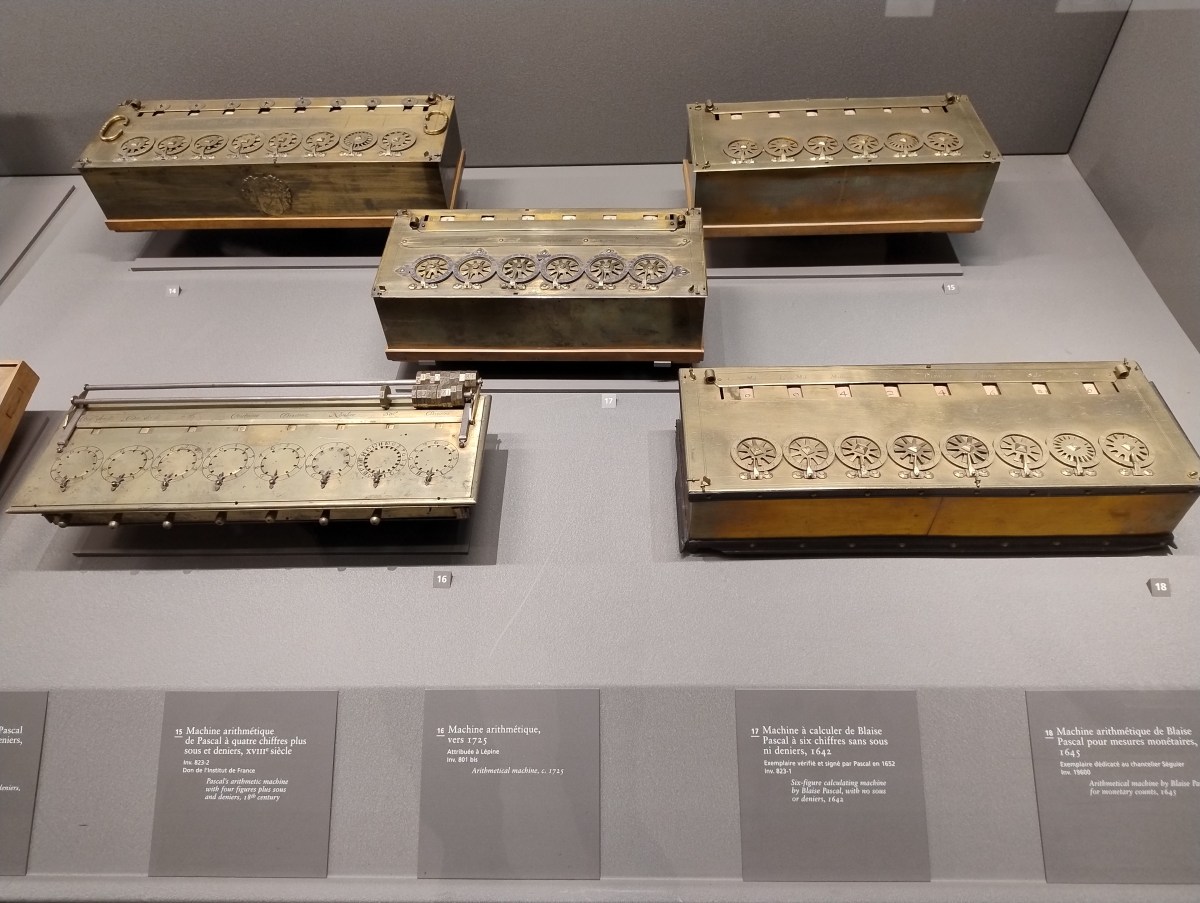
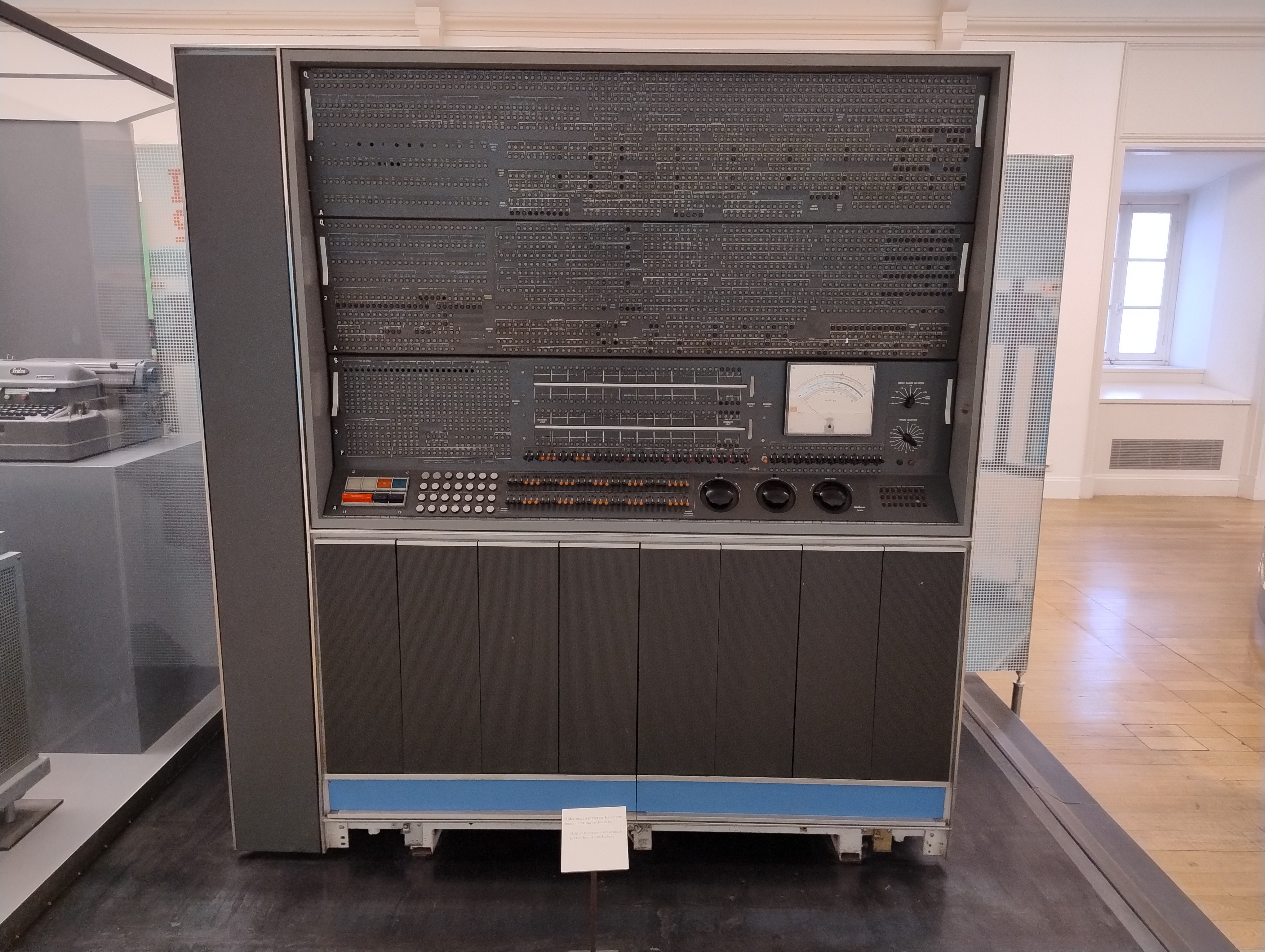
While in Paris I also took the opportunity to visit the Musée des Arts et Métiers, a museum of technological innovation founded in 1794. The museum’s impressive collection includes numerous computing-related items, including several of Blaise Pascal’s ‘Pascaline’ calculators (as described in Chapter 1 of The Story of the Computer), the control panel from an IBM 7030 ‘Stretch’ computer (see Chapter 7 of the book) and a Cray 2 supercomputer. Here are some photos I took of these items:-

IBM 7030 Control Panel
Cray 2 Supercomputer

The March of Progress

After starting work on my third book in January 2023, I’ve been making steady progress. With initial drafts of the first five chapters now done and dusted (out of a planned total of eight), I’m currently more than halfway through and anticipating completion towards the end of 2025. As reported in my previous post, the subject of the book is the history of music technology. However, it won’t cover the development of acoustic musical instruments as there are many excellent books available on that subject already. Instead, it will concentrate on the application of mechanical, electrical and electronic technology to music.

You can get an impression of the scope of the book from the chapter headings:-

  1. The Mechanical Age
  2. Understanding Sound
  3. Sound Recording and Reproduction
  4. Electromechanical and Electromagnetic Instruments
  5. The Electrification of the Guitar
  6. Analogue Electronic Instruments
  7. The Advent of the Electronic Synthesiser
  8. The Digital Revolution

Although the writing hasn’t gotten any easier third time around, I’ve found that conducting the research for this latest book has been eased slightly due to an increase in the amount of source material available online. When writing my first book, The Story of the Computer: A Technical and Business History, which I started working on in 2003, I relied heavily on the physical collections of the University of Glasgow library for my research, as much of the source material required was not available online at that time. With my second book, The Story of the Robot: A Short History of Automation and Robotics, which I started working on in 2017, the situation had improved considerably but I still had to seek out physical copies of some of the source material. This time around I’ve been able to find almost everything I need online which has saved me a huge amount of time in carrying out my research.

One of the most useful online resources has been the Internet Archive, a web archive and digital library founded by the American internet entrepreneur Brewster Kahle. It’s absolutely huge and well worth checking out if you are carrying out any research of your own.

That Difficult Third Album

Having completed and published both the paperback and eBook versions of The Story of the Robot in July last year after nearly 3 years of effort, I was in no hurry to start another writing project. I’d succeeded in proving to myself that I could write a second book. Also, having covered the two areas of technology which I can claim some expertise in (computers and automation systems), I reckoned I had run out of suitable topics to cover.

However, there was one piece of unfinished business. When writing my first book, The Story of the Computer: A Technical and Business History, I’d omitted planned chapters on supercomputers and portable computers in order to keep the overall length of the book manageable. Perhaps one of these could be the subject of a new book?

I quickly ruled out supercomputers. Supercomputing is a highly specialised subject and my experience of it is limited so a full-length book on its origins and evolution would be a tall order for me and probably also of little interest to potential readers. That left portable computers.

I have to confess to disliking portable computing devices. I get frustrated by their tiny virtual or physical keyboards, miniscule screens and absence of a decent pointing device. I don’t actually want to compose an e-mail while walking down the street or in the back seat of a taxi. I’d rather do it from the comfort of my desk, where I can give the task my full attention without fear that my user experience will be severely compromised by the Lilliputian nature of the equipment. Despite this, I can’t help marvelling at the ingenuity of their design and the enormous effort that has gone into their development.

Therefore, in August 2022 I began scoping out a book on the history of portable computing technology with the working title ‘A Moving Story‘. After a few weeks of intensive research I had a rough outline of the new book, complete with chapter headings, subheadings and bullet points for content. The next stage would be to take each chapter outline and expand it into working draft but I now realised that I’d be going over much of the same old ground as The Story of the Computer, as portable computers are still computers after all, and this dampened my enthusiasm considerably. I needed to find a different subject if I was to have any hope of writing a third book, a subject that I had both the enthusiasm for and sufficient knowledge of.

In September 2022 I attended a reunion of former colleagues from the University of Glasgow. During a conversation with one of my oldest ex-colleagues, I mentioned my struggle to find a suitable subject for a third book. Knowing that I was a keen amateur musician with an abiding interest in the technological aspects of music making, he suggested the history of music technology. After mulling this suggestion over for a couple of months, I decided that it was indeed the right subject for my next book.

I’ve now completed an outline for the new book, which has the working title ‘Turn Up the Volume‘, and have started work on the first draft of Chapter 1. Music technology overlaps with automation and computing at several points in its history, which gives the book a sense of continuity with the two earlier books while remaining a standalone work. Progress was slow to begin with due to the large amount of background research required for a “new” subject but is now accelerating rapidly as my enthusiasm builds. The target date for completion is early 2026 so watch this space!

A Local Resource

One of the most challenging tasks I had when creating my latest book, The Story of the Robot: A Short History of Automation and Robotics, was finding suitable images that could be used without royalty fees or onerous licensing restrictions. The Internet is a rich source of images on all manner of subjects but the majority of these cannot be used without first obtaining a license unless the copyright has expired or the image has been made available under a public copyright license. You can see evidence of this on many Wikipedia pages, where images are either non-existent or are photographs of questionable quality taken by amateurs and licensed through Creative Commons.

Chapters 2 and 3 of the book were particularly challenging, as the choice of royalty-free images of early factory machinery was very poor. In some cases I was able to find PDF copies of relevant documents where the copyright had long since expired, such as early manuscripts and patent applications, and extract suitable images from them. I also had a few photographs of museum exhibits which I’d taken myself. However, this situation was less than ideal and ended up limiting the number of images included in the book.

Imagine my surprise when, on a recent visit to the National Museum of Scotland here in Edinburgh, I discovered a treasure trove of artefacts from the Industrial Revolution, including many of the items of machinery I had been writing about in the book. I’ve visited this excellent museum on countless occasions over the years but had somehow missed (or forgotten about) the ‘Scotland Transformed’ gallery which takes the visitor through the period during which Scotland began to change from a predominantly rural, medieval society to an urban, modern one. It’s a pity that I hadn’t found it before publishing the book, as I would have been able to include my own photographs of the relevant artefacts (see example above). Of course, this opens up the possibility of a new edition of the book containing a much larger number of images, as originally planned, but I’ll leave it for the time being and see how sales of the first edition progress.

An Impressive Collection

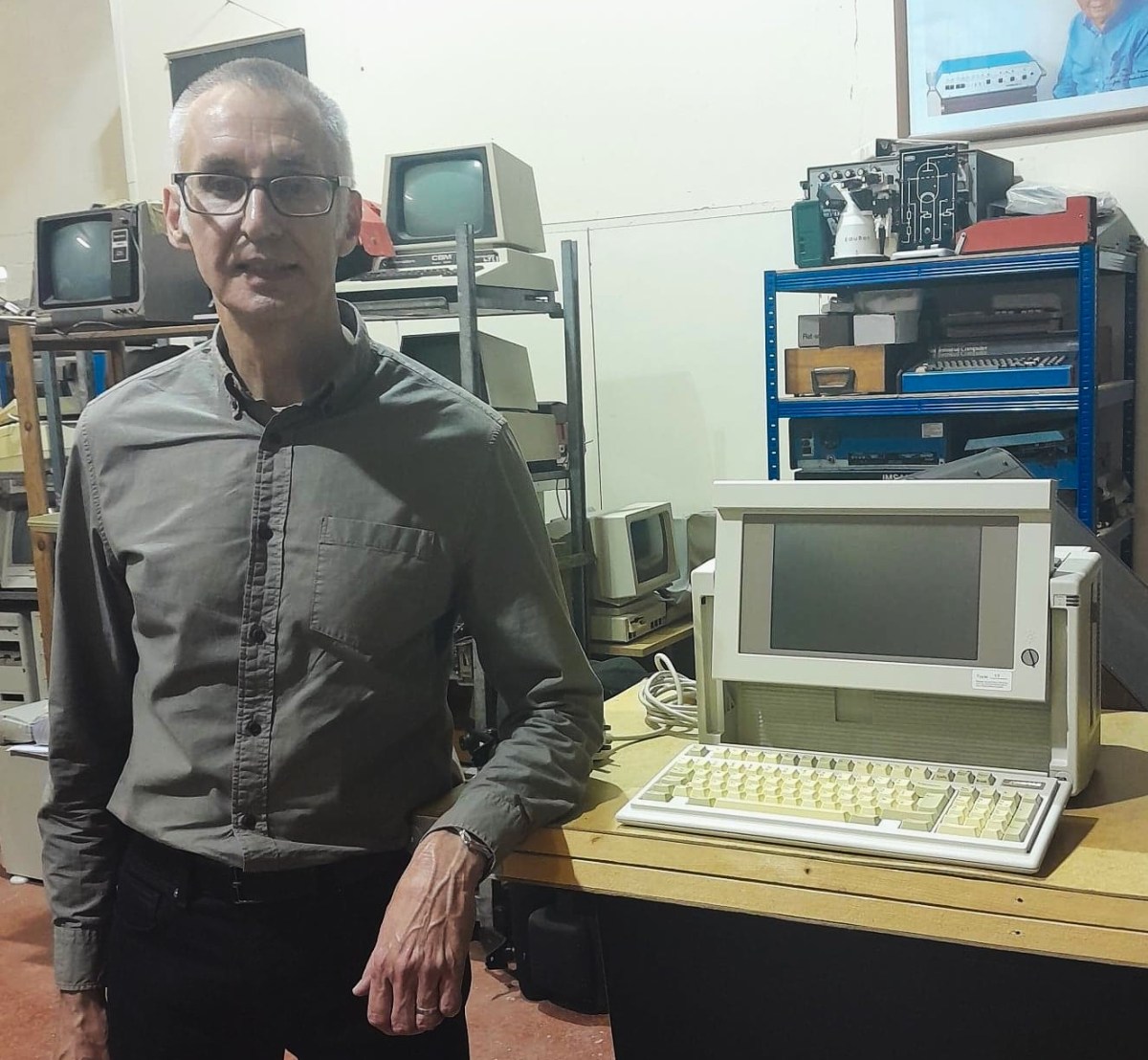
I recently had the pleasure of visiting the Time-Line Computer Archive, a large collection of vintage computers located in Wigton, Cumbria. The aim of the Archive is to collect, restore and exhibit all types of early computers, electronics and associated peripherals. The collection boasts a number of historically important computers, including an English Electric DEUCE, Librascope Royal Precision LGP-30, IBM 1620, several Digital Equipment Corporation PDP minicomputers and a Kenbak-1 personal computer, one of only 14 believed to still exist.

The main reason for my visit was to donate a Compaq Portable 386 Model 2670 computer which I’d rescued from a skip many years ago (see photo above). The Archive is not currently open to the public so it was an honour to be given a private tour by curator Mike Armstrong. Mike’s knowledge and enthusiasm for the subject made for a most enjoyable visit.

The eBook Dilemma

When publishing my new paperback, The Story of the Robot, a few weeks ago via Amazon’s Kindle Direct Publishing platform, I decided initially not to create an eBook version. My main reason for this decision was the eBook format’s inability to support a proper index. This is no big deal for fiction books but can be a major drawback for non-fiction titles, where the reader relies on the index to dip in and out of the book in order to check facts or re-read certain sections.

Another reason was what I assumed to be the difficult and time-consuming task of reformatting my painstakingly formatted manuscript to make it suitable for an eBook. Unlike my previous book, The Story of the Computer, I’d gone straight to a highly formatted paperback edition, which I created using Adobe InDesign, rather than the more logical route of starting with a relatively unformatted eBook version before moving onto the paperback. InDesign does support eBook output formats but this would have meant manually stripping out all the paperback-specific formatting, a process that was likely to take some time and considerable trial and error to complete.

However, with initial sales of the new book in single figures, I soon realised that having an eBook version might help to stimulate demand. My previous book has sold in similar numbers of both formats over the past 5 years (although eBook sales do appear to be tailing off) and there is also the additional benefit of royalties from the Kindle Unlimited scheme, where you get paid for the number of pages a Kindle Unlimited subscriber reads in your eBook for the first time.

Having convinced myself of the need for an eBook version, I then investigated the options available for creating it. Several online resources suggested using Amazon’s Kindle Create to produce the eBook rather than doing it within InDesign. Kindle Create is a free desktop application that produces eBook interiors in Kindle Create Publishable Format (KPF) for publishing directly on the Kindle store. It will accept files in Microsoft Word format and will do its best to replicate the Word formatting in the eBook. As I’d written my book using MS Word before turning to InDesign to create the finished version, this sounded like the easiest option.

The conversion process was relatively straighforward, although Kindle Create does have a number of annoying bugs which required manual adjustment of formatting settings to bring certain elements back into line. The software is also quite limited in terms of functionality, particularly in how it handles images. Fortunately, it includes a built-in previewer which lets you see exactly how your eBook will look on a tablet, phone or Kindle reader. I found this feature invaluable for picking up several minor formatting issues that had crept into the eBook during the conversion process. Producing the eBook using Kindle Create took me about a day and a half, which was less time than expected and a fraction of the time taken to produce the paperback version using InDesign. It will be very interesting to see if having an eBook version has the desired effect in boosting sales of the new book!

New Book Completed

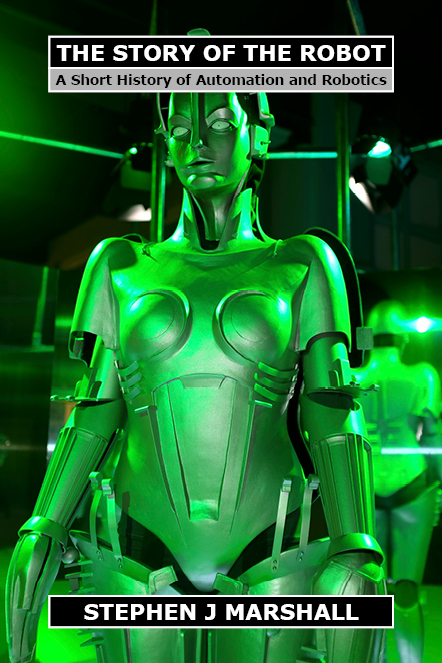
My new book is now finished and is available in paperback format through Amazon. Titled The Story of the Robot: A Short History of Automation and Robotics, the book examines the history of the robot within the wider context of automation, thereby allowing the reader to fully appreciate the origins and evolution of robotic systems.

It begins by tracing the historical roots of robotics through the development of automata and mechanical toys.  The next four chapters guide the reader on a whistle-stop tour across more than 300 years of automation history.  Chapter 6 charts the rise of humanoid robots, beginning with their first appearance in science fiction stories to their physical realisation at the end of the 20th century.  In Chapter 7, the use of autonomous control technology in mobility applications is surveyed, from the earliest self-steering vehicles to autonomous robots and self-driving cars.  The final chapter brings the story up to date with the new industrial revolution now taking place as a result of the application of digitalisation and interconnectivity technologies to manufacturing.

Weighing in at a svelte 70,000 words, it’s much shorter than my first book but it still took around 3 years to research and write plus another couple of months to format for publishing using Adobe InDesign. Given my failure to attract a publisher for my first book, I decided not to waste my time again and went straight for the self-publishing option through Amazon’s KDP platform. Who knows, if the book does well it might attract the attention of a publisher.

Steady Progress

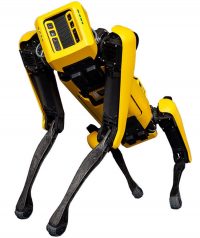
Boston Dynamics SpotI’ve now completed the first two chapters of my new book and have almost finished the first draft of Chapter 3.  The working title is The Story of the Robot: A Short History of Automation and Robotics.  As the title indicates, this will be a shorter book than The Story of the Computer, with 8 chapters planned instead of 13 and a relatively svelte estimated word count of around 80,000 words in contrast to the massive 235,000 words of my first book.

There are a couple of reasons for this:-

    1. The only real criticism of The Story of the Computer concerned its length which appears to have daunted some readers and scared off at least one potential publisher.  The book had to be long in order to cover the multiple development paths and competing technologies adequately, and would have been even longer if I had not decided to omit planned chapters on supercomputers and portable computing.  Fortunately, the subject of the new book is less convoluted and can be covered in a much more straightforward way.
    2. With over 500 pages of text in The Story of the Computer, I could only include a relatively small number of illustrations otherwise the total number of pages would have become unmanageable.  This was frustrating, as certain sections of the book would have benefitted from the addition of some carefully chosen images.  Having less text in the new book affords me the luxury of including as many illustrations as I like without worrying about the overall number of pages, although it will be a challenge to find sufficient good quality images in a subject area that is much less well represented online than the history of the computer.

Progress with the new book has been steady but slower than I’d have liked (due mainly to a lack of discipline on my part!).  Nevertheless, Chapter 3 should be finished by the end of this month and I’ll aim to increase the pace in the New Year to get back on track for completion of the book before the end of 2021.