
The Military Origins of Electronic Computers

The BBC News web site carried an article last week about the tragic death of a British soldier in Afghanistan.  What made this story different from the depressingly constant stream of similar reports was that his death was caused by a data error.  He was killed by a smoke shell fired from a British artillery weapon which fell short of its target due to an error in the data used to compensate for the effects of weather conditions on the shell’s flight.  The computer system which would normally provide this data automatically was not working so the gunners had to input the data manually.  Unfortunately, they used the wrong data, with tragic consequences.

Ironically, one of the driving forces behind the development of electronic computers was the need for accurate artillery firing tables.  In the days before fully computerised fire control systems, these tables provided the settings that gunners require to compensate for the effects of external factors (such as wind speed and direction, air temperature and the rotation of the Earth) on the trajectory of an artillery shell.  However, the preparation of such tables was very labour intensive, with a single trajectory taking two full working days to calculate using a mechanical desk calculator, and the increased demand for them during World War II prompted the US Army to fund the development of calculating machinery which could speed up this process.  This resulted in the development of the first general-purpose electronic digital calculator, the Electronic Numerical Integrator and Computer (ENIAC).
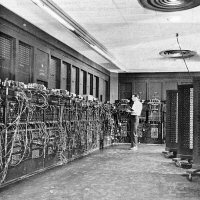
ENIAC

ENIAC was developed at the University of Pennsylvania’s Moore School of Electrical Engineering in Philadelphia.  The completed machine weighed over 30 tonnes and its cabinets lined the walls of a room 50 feet long by 30 feet wide.  Although ENIAC’s main purpose was to perform calculations for artillery firing tables, it also possessed the flexibility to cope with a wider range of computational problems.  The insights which the ENIAC project team gained through providing this extra flexibility led directly to the development of the stored-program computers that we use today.

The two men who led the development of ENIAC, John Mauchly and Presper Eckert, went on to create the UNIVAC I, one of the first computers to reach the market.  UNIVAC I was designed primarily for business data processing but its origins, and the origins of all stored-program electronic digital computers, can be traced back to the US Army’s need for artillery firing tables during World War II.

A Wealth of Information

One of the great challenges in writing a non-fiction book is gathering the primary source material.  Since I began writing 10 years ago, the quantity and quality of information available on computers and the computer industry via the Web has increased enormously.  I’m fortunate to have access to the massive collection of over 2.5 million books and journals in the University of Glasgow Library through my day job but in most cases I can now find the information I need simply by typing some carefully chosen keywords into a search engine and clicking on a few links.  It’s amazing to think that only 20 years ago much of the material used in the preparation of this book would have been extremely difficult or in some cases impossible to find.  Now anyone with a smartphone and an Internet connection can access it online.

I plan to create a comprehensive list of available online resources at some point in the future.  In the meantime, here are a few I’ve found to be particularly useful:-

Fumbling the Future

As part of my research for Chapter 12, I’ve recently finished reading the book Fumbling the Future: How Xerox Invented, then Ignored, the First Personal Computer.  The book was written in 1999 by Douglas K Smith and Robert C Alexander, two Harvard educated management consultants.  It chronicles the establishment of Xerox PARC, a corporate research facility set up by the US photocopier giant in 1970 to support the company’s diversification into computers, and the subsequent creation of a groundbreaking personal computer system by one of the most inventive research groups in the history of the computer.

Fumbling the Future does a good job of explaining why Xerox needed to diversify in the first place and describing the corporate politics which prevented the company from taking full advantage of the amazing computer technology developed at PARC.  Where the book isn’t quite so authoritative, however, is when it comes to the technology itself.

One of the reasons for the commercial failure of the personal interactive computer systems developed at PARC was that Xerox did not recognise the changes taking place elsewhere in the computer industry.  The Xerox Alto and its commercial offspring the Xerox 8010 Star were based on a minicomputer architecture but while they were being developed the industry was moving away from minicomputer-based systems to low-cost microcomputers.  By the time that the Star was introduced in April 1981, the market was already awash with inexpensive microcomputers from companies such as Apple, Commodore and Radio Shack.  The Star was clearly a superior product with a revolutionary graphical user interface which made it much easier to use than other personal computers but it was also much more expensive, costing more than 10 times as much as an Apple II.  When IBM introduced the 5150 PC a few months later in August 1981, the struggling Xerox Star was dead in the water.

Fortunately for Xerox, other technologies developed at PARC were successfully commercialised, such as Ethernet, which became the industry standard for connecting computers over a network, and the laser printer which generated many millions of dollars in product sales and licensing income for the company.  PARC also spawned numerous spin-outs, at least two of which (3Com and Adobe Systems) became household names.  Although Xerox failed to make money from it, PARC’s graphical user interface technology was the inspiration for both the Apple Macintosh and Microsoft Windows, and no modern personal computing device is complete without a user interface that owes its existence to the work of Xerox PARC.

A New Web Site

I’ve done it. I’ve finally created a web site and blog to tell the world what I’ve been spending all my spare time working on for the past 10 years. My thanks to Dr Scott Sherwood who provided the motivational push to get me started and also recommended using WordPress to create and maintain the site. It’s been a number of years since I was involved in web site development and the technology would appear to have improved immensely! It’s early days but the only problems encountered so far have all been caused by using Internet Explorer 8 rather than one of the newer browsers. These problems were easily fixed by installing the latest version of Mozilla Firefox.

My next task will be to provide a sample chapter of the book which can be freely downloaded from the site.  I’ll also add some appropriate images to make the site look less boring.